Booking Reconciliation
Travel Booking Reconciliation for Tour Operators
Compare customer bookings with supplier confirmations and expose date, transfer and service discrepancies before they reach the traveller.
The Commercial Opportunity
A booking error can affect transfers, tickets, payments and the customer’s trust. Finding a mismatch before those next steps gives the team time to act while the original evidence is still easy to trace.
The binding customer booking or travel contract is the reference. Hotel, tour, transfer and other supplier confirmations may arrive as emails, PDFs, scans or external booking records. The same service can appear under a different name, language or date format. Transfers may depend on separate rules, while extras are confirmed in later correspondence.
A Plausible Date Can Still Be Wrong
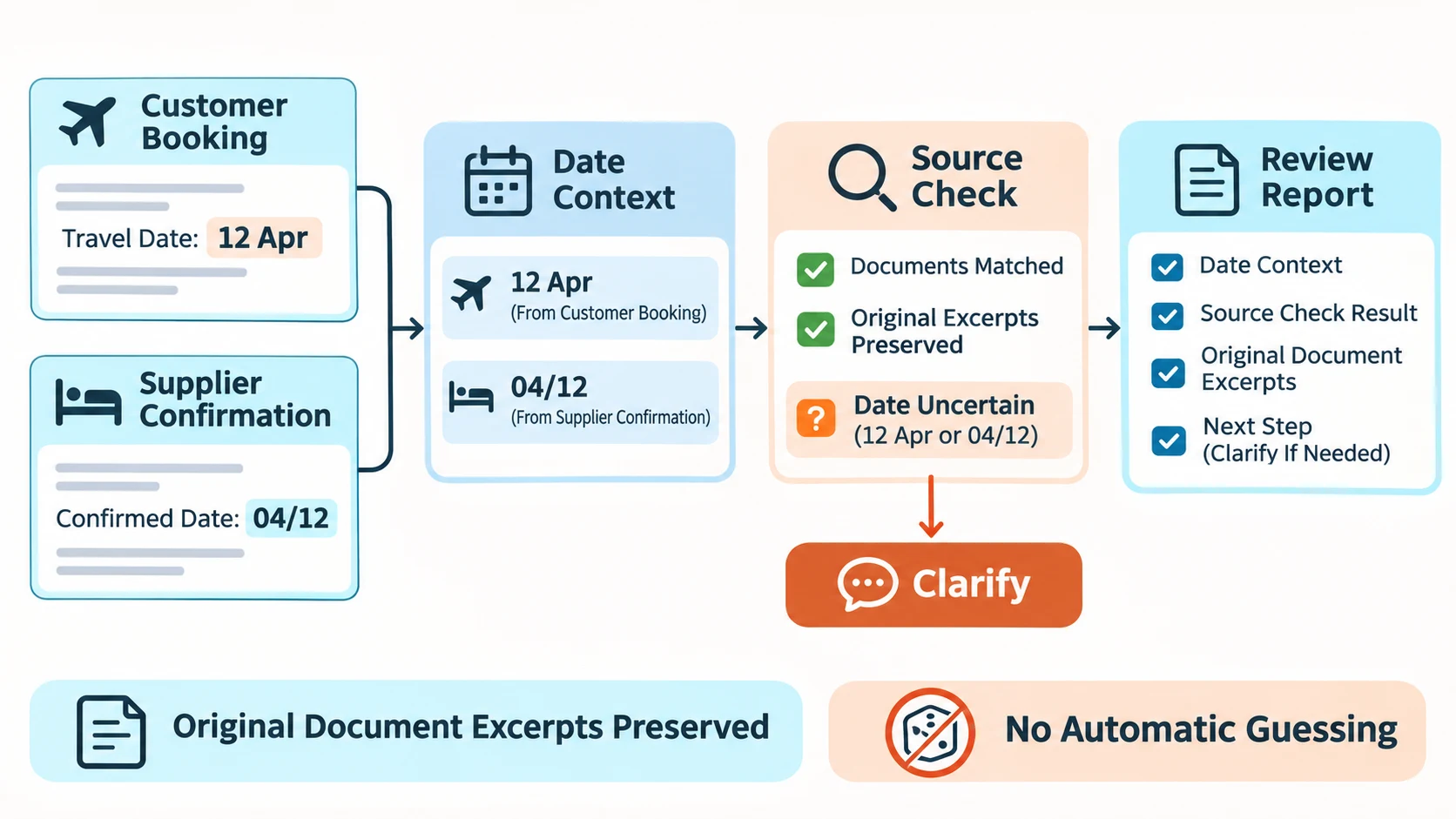
Dates can appear as 04/12, 12 Apr or 12APR25, with no year or with relative wording such as “arrival Monday”, “the following day”, “second night” or “return after four nights”.
These details need the journey context. A wrongly interpreted day can make a transfer appear to fit even though arrival or departure is wrong. Services outside the stay can pass later checks if the initial date is accepted without evidence.
A Controlled Workflow
Normalise Each Source Separately
The customer contract and each supplier confirmation retain separate data records. The workflow extracts travel dates, traveller count, product and supplier names, flights, transfers and extras, while keeping the original material.
For each date, it identifies format and language, links the interpretation to the original passage, then checks order, journey period and duration. Missing values or inconsistent start and end dates can trigger a second extraction. An unresolved date stays unresolved.
Compare the Journey and Its Services
Checks cover:
- Travel dates and additional services that could explain a difference.
- Traveller counts on both sides.
- Flight and arrival segments with dates, times and locations.
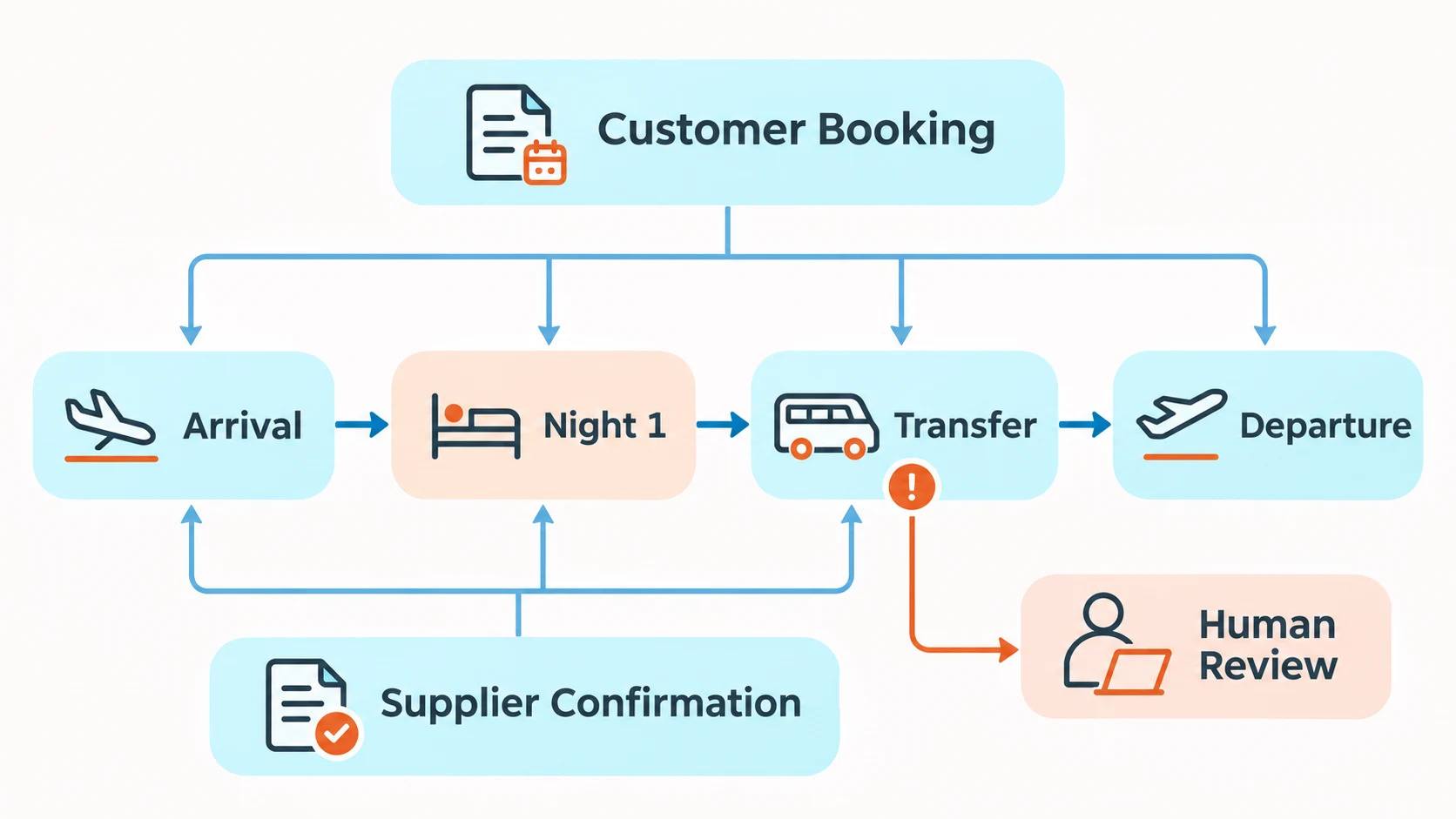
- Transfers against arrival, departure, airport and the stay.
- Supplier extras with similar or different descriptions.
- Additional services using confirmation references and related emails.
The report distinguishes confirmed matches, explained differences, missing information and issues requiring clarification. Similar product names alone do not prove that two services are identical.
Information and System Requirements
The workflow connects current customer and booking records, supplier confirmations, product and transfer rules and relevant flight or email information. It needs:
- Journey start, end, duration and individual service periods.
- Travellers, booked variant, rooming and supplier names.
- Arrival and departure segments, airports and transfer conditions.
- Extras, confirmation references and correspondence.
- Permitted formats, languages, relative date rules and defined exceptions.
Flights and journeys are split into segments rather than compared as two text blocks. Stable booking references and agreed comparison fields connect the records. Checks can run at confirmation milestones or for a defined review.
Preserve a Report Rather Than Quietly Changing Records
Every assessment retains its sources, recognised date conventions and reasoning. The process does not correct a booking autonomously or replace a missing supplier confirmation.
Tests cover routine matches, known formats, missing years, day names, relative wording, language changes and extras outside the journey. New suppliers and confirmation formats become additional test cases.
Potential and Limits
The team can focus on discrepancies before ticketing, travel documents, payment or customer communication. Each review item already identifies the affected information, source and reason for concern.
Incomplete or contradictory confirmations remain clarification cases. An operations owner decides on corrections, questions and final approval. Confirmed costs can then support travel accounting.
Before Choosing This Use Case
We assess the records, rules and current review workload before deciding:
- Which bookings and confirmations does the team check manually, and where do discrepancies cause repeat work, errors or delays?
- Which customer contracts, supplier confirmations, flight and transfer data, emails and comparison rules are accessible and reliable?
- Which discrepancies must remain visible, and who owns investigation, supplier contact, correction and approval?
The findings establish commercial suitability, missing requirements and a sensible scope. An AI Audit considers this alongside other priorities.
A Clear Starting Point
Find the Right AI Path for Your Travel Business
An AI Audit prioritises the travel processes worth exploring and clarifies the systems, information and responsibilities needed for a sound next decision.
Contact us