Customer Questions
AI Customer Service for Travel Agencies
Research unusual customer questions against approved internal and public sources, with evidence and a clear route for unresolved cases.
The Commercial Opportunity
A customer question can carry consequences for trust and the travel decision. Giving the team an evidence-based starting point reduces repeated searches and helps it respond without promising a service that has not been confirmed.
Customers describe wishes and concerns across email, chat and phone. Is accommodation suitable for an allergy? Can a dietary requirement be met? Who can confirm an unusual transfer time? Answers may sit in product descriptions, company information, supplier guidance or a current public notice. A similar trip is not evidence for a specific promise.
Give Uncertainty an Owner
Questions about accessibility, health requirements, rooming, special transfers or temporary exceptions may need a product specialist or the local supplier. A useful result identifies that responsibility and carries the research forward.
A Controlled Workflow
Turn the Message into Questions That Can Be Checked
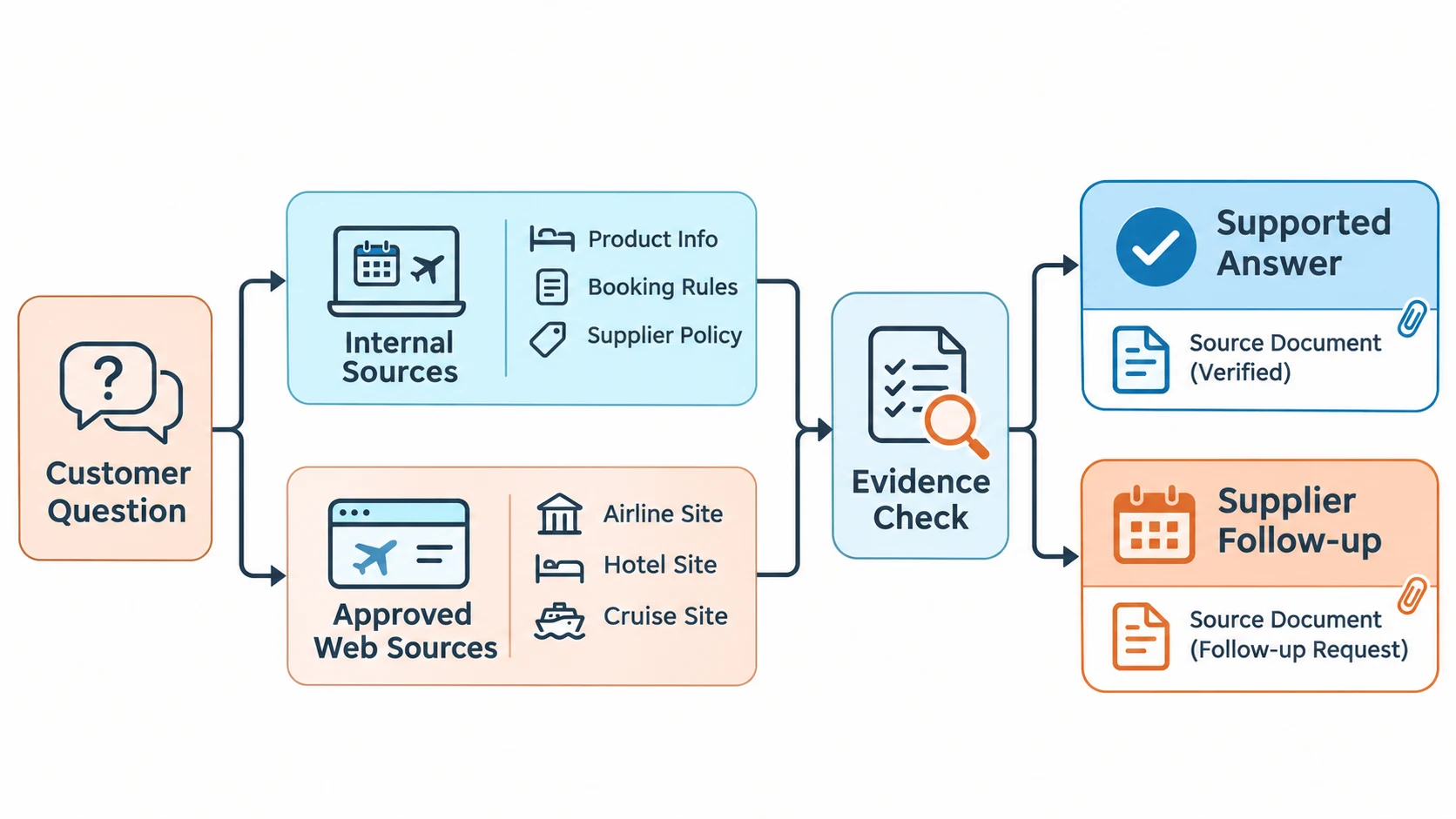
The enquiry becomes a set of decision-relevant questions. Each remains tied to the customer’s actual words, journey, supplier or place. Dates, prices and standard inclusions are checked in the responsible system; unusual or undocumented requirements follow the source research route.
The same service can support a website chatbot, staff in customer service, personal advice and email enquiries.
Search Internally, Then Follow the Gaps
For each question, the process searches product information, company pages and supplier documents in parallel. It combines terms and full text with semantic search. A draft answer retains a concrete source extract and its relationship to the relevant journey, supplier or location.
Where the internal evidence is incomplete, approved public sources can extend the search. The actual page is read and assessed. A search snippet alone is insufficient.
Before an answer is used, the process checks direct support, source authority, exact relevance, freshness and conflicts. Open points are assigned to the internal team, supplier or specialist who can resolve them, or marked as unanswerable from the available evidence.
Information and System Requirements
The searchable information base needs:
- Maintained travel, product and service descriptions.
- Supplier documents linked to the correct product, provider or location.
- Structured dates, prices and availability.
- Suitable public sources with retrieval times and source assessments.
- Ownership rules for updates, escalation and topics that never receive automatic answers.
Search results are limited by source, language and the specific case. Public information supplements the evidence; it cannot replace an authorised supplier commitment.
Carry the Context into the Handover
The answer shows what is supported, where it came from and what remains open. If one part is answered and another is not, that distinction is preserved.
Operation defines permitted internal data areas, update ownership and acceptable public domains or source groups. The receiving person gets the question, customer context, checked sources and unresolved issue.
Potential and Limits
The team begins with a broader, traceable view rather than separate fragments from systems and the web. This can reduce repeated research and make exceptional requests easier to resolve.
Confidential data, binding promises, conflicting sources and insufficient freshness end the automatic answer route. Booking, price, availability and exceptions remain with the authorised person. A clear referral is a useful outcome when a direct answer cannot be supported.
Before Choosing This Use Case
Before implementing the research service, we assess:
- Which questions require manual research today, how long does it take and where do missing details create further correspondence?
- Which internal sources, product data, supplier information, permitted public sources and ownership rules are reliable and current?
- Which questions and consequences must remain visible, and who approves answers, handles escalation and contacts the supplier?
The assessment establishes whether the work is commercially worthwhile and which requirements must come first. An AI Audit provides that decision basis.
A Clear Starting Point
Find the Right AI Path for Your Travel Business
An AI Audit prioritises the travel processes worth exploring and clarifies the systems, information and responsibilities needed for a sound next decision.
Contact us