Email Enquiries
AI Travel Enquiry Handling by Email
Prepare the research and sources behind each response so your team can focus on advice, decisions and the customer relationship.
The Commercial Opportunity
As enquiry volumes grow, the challenge is not simply replying faster. It is protecting the quality of the first meaningful response without increasing research effort and team pressure at the same rate.
Every travel enquiry is a moment of intent. A traveller may have described dates, party size, destination, preferred travel style, budget, departure point and special requirements across several messages. Turning that context into a well prepared next step gives the team more room for advice, conversion and the customer relationship.
Make the First Meaningful Response Count
Writing a friendly email is only one part of the work. A strong response begins by deciding which research the enquiry needs. Some cases need a quick orientation, some require a sourced answer to a specific question and others need detailed offer research across dates, routes, flights and options.
A structured process gives each case the appropriate depth. It directs routine questions efficiently and gives more complex enquiries the attention they deserve.
A Controlled Workflow
Keep the Email as the Leading Case
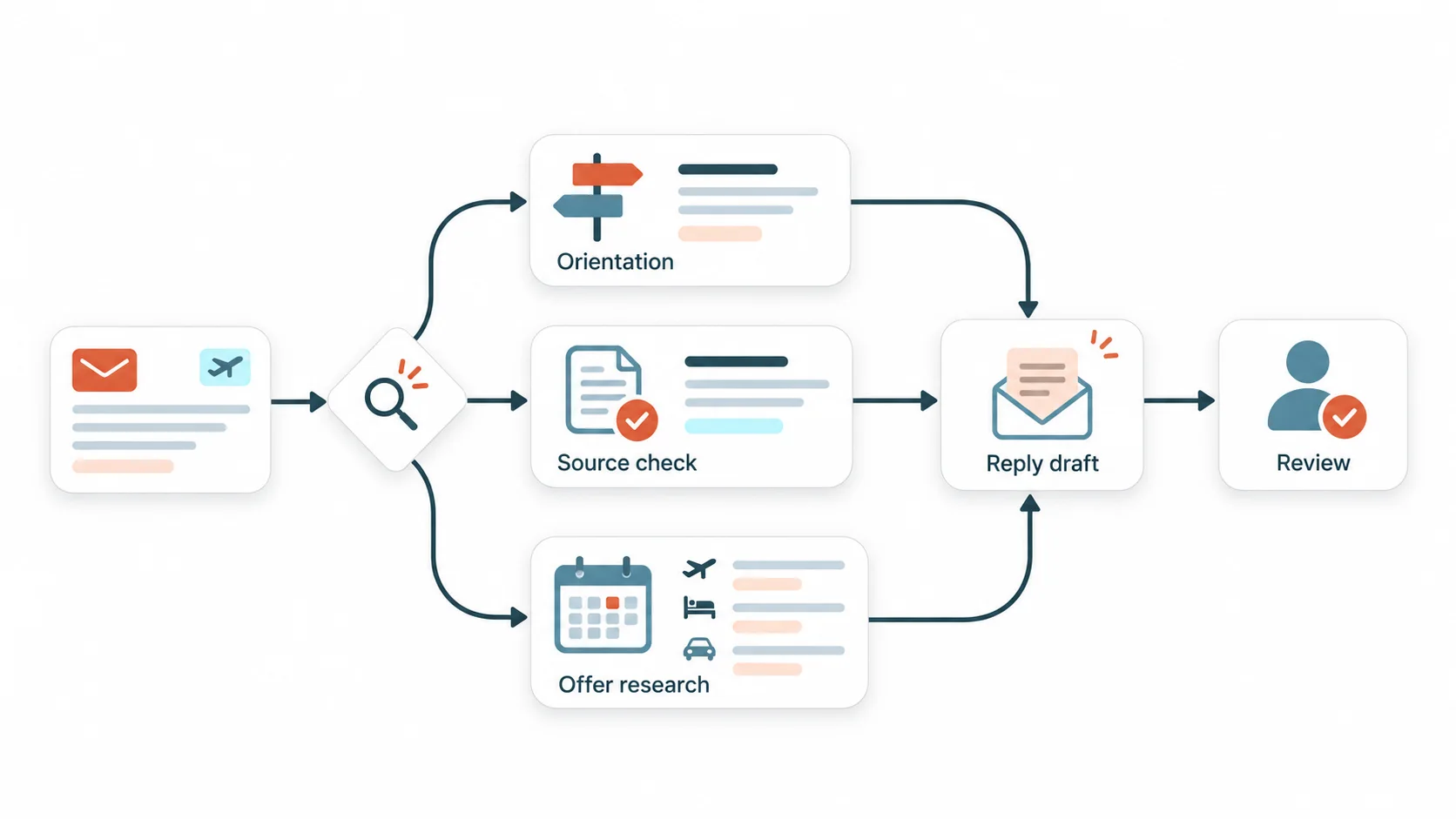
The email thread remains the leading case record. The current message, existing customer and case context and the stated requirements form a focused work plan of two to five tasks. New information can update that plan as the conversation develops.
The process selects only the work needed for the particular enquiry:
- Quick travel research can identify initial options, alternatives and missing details.
- A source check can answer a specific or unusual requirement against approved internal information and, where appropriate, suitable external sources.
- Detailed offer research can prepare more demanding options with dates, routes, flights and offer details.
Bring the Evidence Together Before the Draft
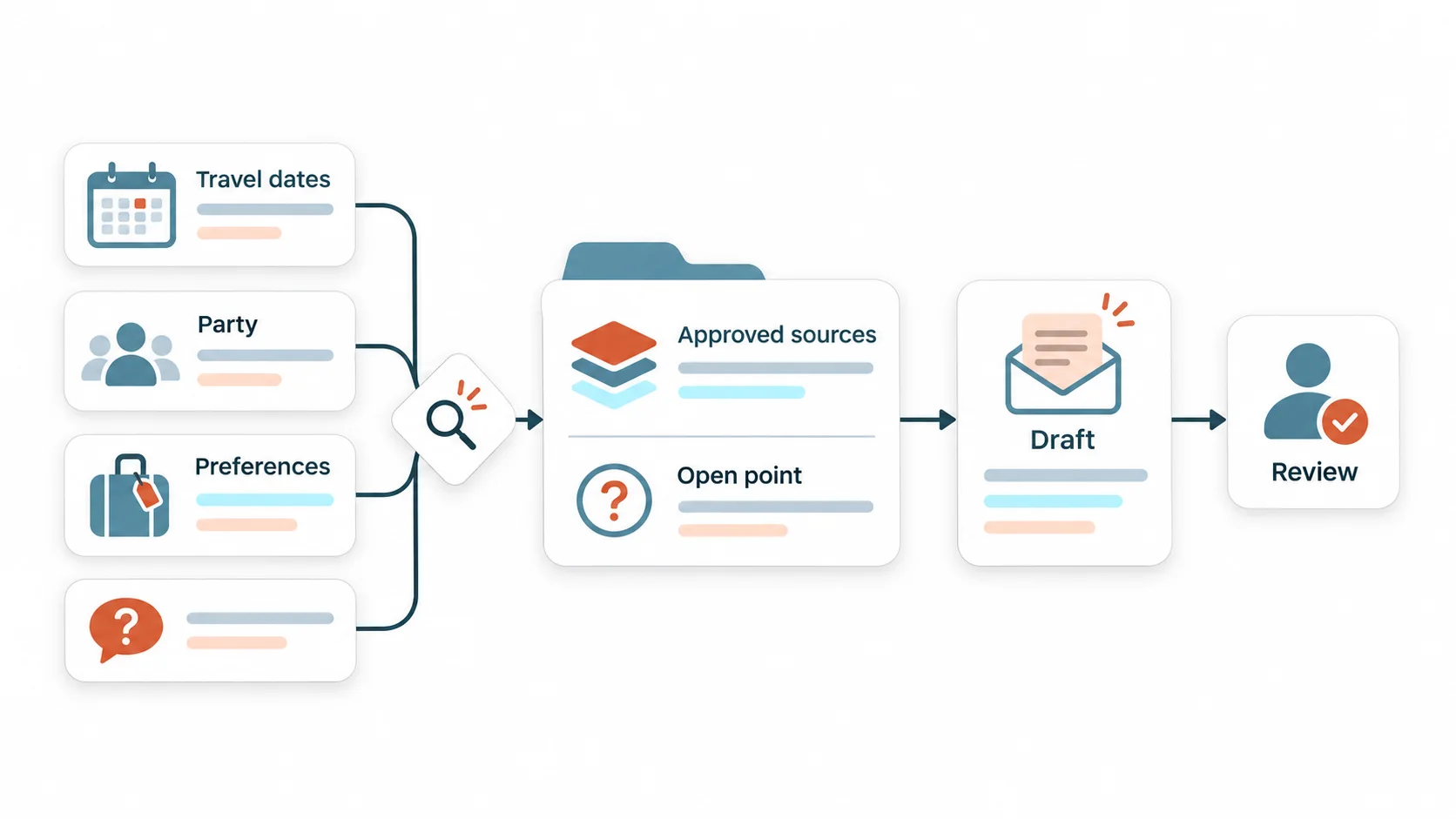
The results return to one response draft. Suitable options, confirmed statements, source notes, customer questions and open points remain distinct. The opening refers to the customer’s actual enquiry, while every statement in the response can be traced to the enquiry, an approved source or an explicit question.
Information and System Requirements
The process brings together the email, CRM and case context, product and departure data and the outputs of the selected research tasks. Each input remains attributable to the individual enquiry, so the team can see what came from the customer, an approved source or an open question.
Dates, prices and availability come from the systems responsible for them. Special requirements need a specific source reference. The implementation defines source priorities, access permissions, ownership and the limits of each research task before it is used in day to day work.
Open email cases are processed within a defined period. New information can refresh the work, while unchanged cases retain their existing result. Technical issues, incomplete context and unresolved questions are handed to the responsible person with the existing case context. Tests with complete, incomplete and conflicting enquiries check the clarity of options, sources, open points and handovers.
Potential and Limits
The workflow does not send emails autonomously or make binding commitments about price, availability, booking, payment or exceptions. Missing evidence, stale information and contradictory findings stay visibly unresolved. The team or supplier receives the case and existing context so a plausible draft is never mistaken for a confirmed service.
The team starts with a prepared response rather than a blank page, and repeat questions do not trigger the same research unnecessarily. In complex cases, research, source checks and offer preparation remain distinct, allowing people to focus on judgement, negotiation and advice.
A travel professional reviews the draft, its sources, offer options, open questions and the consequences of the proposed response. They confirm suitability, availability, price, booking, payment and any exception that requires professional judgement before the response is sent.
This gives the team a prepared starting point for the conversations where expertise, negotiation and personal advice make the greatest difference.
Before Choosing This Use Case
Before selecting this workflow, we review the current cases and responsibilities:
- Which types of travel enquiry are handled manually, how much research and clarification do they require and where do missing details delay a response?
- Which email, CRM, product, departure and source information is current and reliably available for each case?
- Which special cases, uncertainties and binding decisions must remain visible, and who owns review, handover and sending?
The findings establish commercial suitability, missing requirements and the strongest priority. An AI Audit provides that assessment.
See Complex Itinerary and Offer Research for the deeper comparison behind demanding enquiries.
A Clear Starting Point
Find the Right AI Path for Your Travel Business
An AI Audit prioritises the travel processes worth exploring and clarifies the systems, information and responsibilities needed for a sound next decision.
Contact us